The basics

Understanding squash

Squash is quick to learn and hard to master. This page covers everything you really need for your first games — in plain words, without rulebook clauses.

2Players
11Points per game
3 of 5games to win
1Ball, 4 walls

What it’s all about

Two players share an enclosed court and take turns hitting the same ball against the front wall. There is no net and there are no separate halves — both use the same space. That is exactly what gives the game its special character: you aren’t just competing for the ball, you’re competing for space as well.

A rally works like this: after the serve, each player must hit the ball so that it strikes the front wall above the tin and below the out line. The ball may touch the side walls or the back wall as often as it likes, before or after — it just must not hit the floor before reaching the front wall.

The opponent must return the ball before it bounces on the floor twice. So they can play it straight out of the air (volley) or after one bounce. Anyone who fails to do so loses the point.

And because both players share the same space, one key idea applies: your opponent is entitled to direct access to the ball. If you block their way, you are penalised. That is the heart of the rules — and the reason why the centre of the court is so valuable.

The basic principle in one sentence

Play the ball so that your opponent has to run a long way and you only a short way — and don’t get in their way while you do it.

The court

6.40 × 9.75 metres — and every line has a purpose

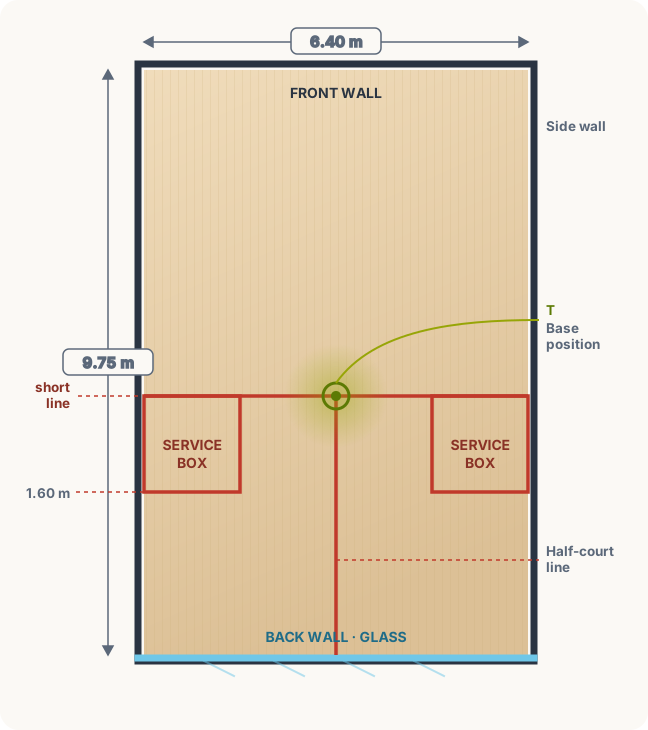
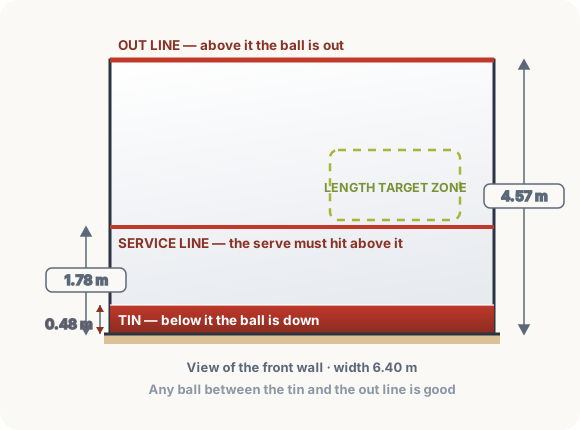
If you know the lines, you’ll understand the rules and tactics much faster. On the left, the view from above; on the right, the front wall.

Floor plan: 6.40 m wide, 9.75 m long, short line, half-court line, two service boxes and the T position in the centre
Front wall: out line at 4.57 m, service line at 1.78 m, tin at 0.48 m high
The key dimensions and lines
ElementDimensionWhat it means in play
Playing area6.40 m × 9.75 mFor singles. Both players share the entire area.
Tin0.48 m highThe metal strip at the bottom of the front wall. If the ball hits it or below it, the point is lost.
Service line1.78 m highThe serve must hit the front wall above this line.
Front out line4.57 m highAbove it, the ball is out. The line itself counts as out.
Back out line2.13 m highOn the back wall the limit is much lower — this is where lots of balls go out.
Short line5.44 m from the front wallDivides the front and back of the court. The serve must land behind it.
Service box1.60 m × 1.60 mWhen serving, one foot must be inside it.
T positionWhere the centre lines meetNot an official rule, but the most important place in squash: the ideal base position.
Simplified rules guide

The rules you really need

Expand and read. The official rules are considerably more extensive — for recreational and league play (up to district level), this core is all you need.

Who serves first is decided at the start — usually by spinning a racket. After that:

  • When striking the ball, one foot must be inside the service box and must not touch its lines.
  • The ball is thrown into the air and struck before it touches the floor.
  • It must hit the front wall above the service line.
  • It must then land in the opposite back quarter, i.e. behind the short line on the other side — or be volleyed by the opponent before it does.
  • There is only one serve. No second serve as in tennis.
  • As long as you keep winning points, you keep serving, switching service box each time. After losing a point, your opponent serves.

Practical tip: The safest serve is high and soft onto the side wall, so that the ball dies in the back corner. Hard serves into the middle are a gift.

After the serve, players hit the ball alternately. A return is good if:

  • the ball is struck before it bounces on the floor twice,
  • it reaches the front wall above the tin before touching the floor,
  • it stays within the out lines.

The side and back walls can be used as often as you like — before or after the front wall. A ball played off the side wall onto the front wall is called a boast; it’s a normal shot, not a trick.

The ball may only be struck once, and the racket must stay in one hand. A ball that hits the racket twice (double hit) is not good.

The point is lost if the ball:

  • touches an out line or hits the wall above it — the line counts as out,
  • hits the tin or the wall below it,
  • bounces twice before being struck (“not up”),
  • fails to reach the front wall,
  • touches the ceiling, a light or anything similar.

Watch out at the back wall: the out line there is only 2.13 m high. Balls hit too high towards the back go out faster than you’d think.

Today, games are scored using point-a-rally scoring: every rally earns a point — regardless of who served.

  • A game is played to 11 points.
  • At 10–10, you have to win by two clear points, i.e. 12–10, 13–11 and so on.
  • A match is played as the best of five games. In recreational play, best of three games is perfectly normal.
  • There is a 90-second break between games.

Calling the score during play: the server calls their own score first, so “5–3” if they have 5.

Two people, a small space, a hard ball and two rackets — safety comes before everything else.

  • If in doubt, stop. If you can’t take a full swing without hitting your opponent, you must stop and ask for a let. That’s not a disadvantage — it’s the rule.
  • Never swing blindly when your opponent is in the way.
  • Protective eyewear is strongly recommended, especially for beginners, juniors and in doubles. Eye injuries are the only truly dangerous injury in squash.
  • After playing your shot, clear the ball and move towards the centre — don’t stand still.
The two key terms

Let or stroke — explained simply

This is where almost all arguments in recreational play come from. But the basic idea is quite simple: your opponent is entitled to direct access to the ball and to a free swing.

Let

The rally is replayed

A let means: no point to anyone, the serve is replayed. It is allowed when the player suffered interference but would have reached the ball and could have made a good return.

  • The opponent is in the movement path but has made a visible effort to clear.
  • A swing would have been possible, but not entirely free.
  • The ball hits the opponent on its way to the front wall, but the return would not clearly have been a winner.
  • Something unforeseen causes a distraction: a second ball on the court, a shout from outside.
Stroke

Point to the player who suffered interference

A stroke means: the player who suffered interference wins the point. It is awarded when the interference cost the player a clear winning opportunity, or when the opponent made no visible effort to clear.

  • The opponent makes no attempt to get out of the way — especially on the T.
  • The player could have hit a winning return but was blocked.
  • The ball hits the opponent when it would have travelled directly to the front wall.
  • The player has to hold back their swing to avoid hitting the opponent.
Rule of thumb for recreational play: If it was your fault that the other player couldn’t play the ball, and they would have won the point — give them the point. If it wasn’t your fault, or the rally was still open — replay the rally. A point given fairly is always better than an argument that ruins the game.

Turning

When a ball comes out of the corner and the player turns round with the ball to play it, a particularly dangerous situation arises. The rule here is: ask for a let rather than play the shot. Safety comes first, and a let is given generously in this situation.

Ball hits the opponent

If the ball hits the opponent on its way to the front wall, the striker is awarded a stroke — provided the ball would have reached the front wall. If it hits them on an indirect path via the side wall, a let is usually the right decision.

Who decides?

In recreational play, the players decide together, there and then. In league play there is a referee, or the players officiate themselves. A let is requested with a clear call of “Let, please” — immediately, not three shots later.

Etiquette

Unwritten rules

Squash depends on players trusting each other in a confined space. These points aren’t at the top of any rulebook, but they decide whether you get invited back.

  • After the rally, pass the ball to your opponent for the serve — don’t kick it away.
  • Apologise briefly if you hit your opponent or got in their way.
  • Before the match, knock up together and swap sides about halfway through so that both of you have warmed up your forehand and backhand.
  • Don’t stop abruptly when your opponent is preparing to play a shot behind you.
  • Keep your towel and drink outside the court — sweat on the floor is the most common cause of slipping.
  • After the match, shake hands or tap rackets. Sounds old-fashioned, but it makes every court a friendlier place.

What you need to get started

  • Racket: Hire rackets are fine to begin with. When buying: 120–145 g, evenly balanced; an open throat is more forgiving.
  • Ball: Red or blue for beginners, yellow later on, double-yellow in competition. Details under Equipment & balls.
  • Shoes: Indoor court shoes with light-coloured, non-marking soles and good lateral support. Running shoes are not suitable.
  • Protective eyewear: inexpensive, lightweight, and the only real protection against eye injuries.

Rules understood — now go and train

The beginners’ session takes you through grip, forehand, backhand, serve and your first points in 45 minutes.